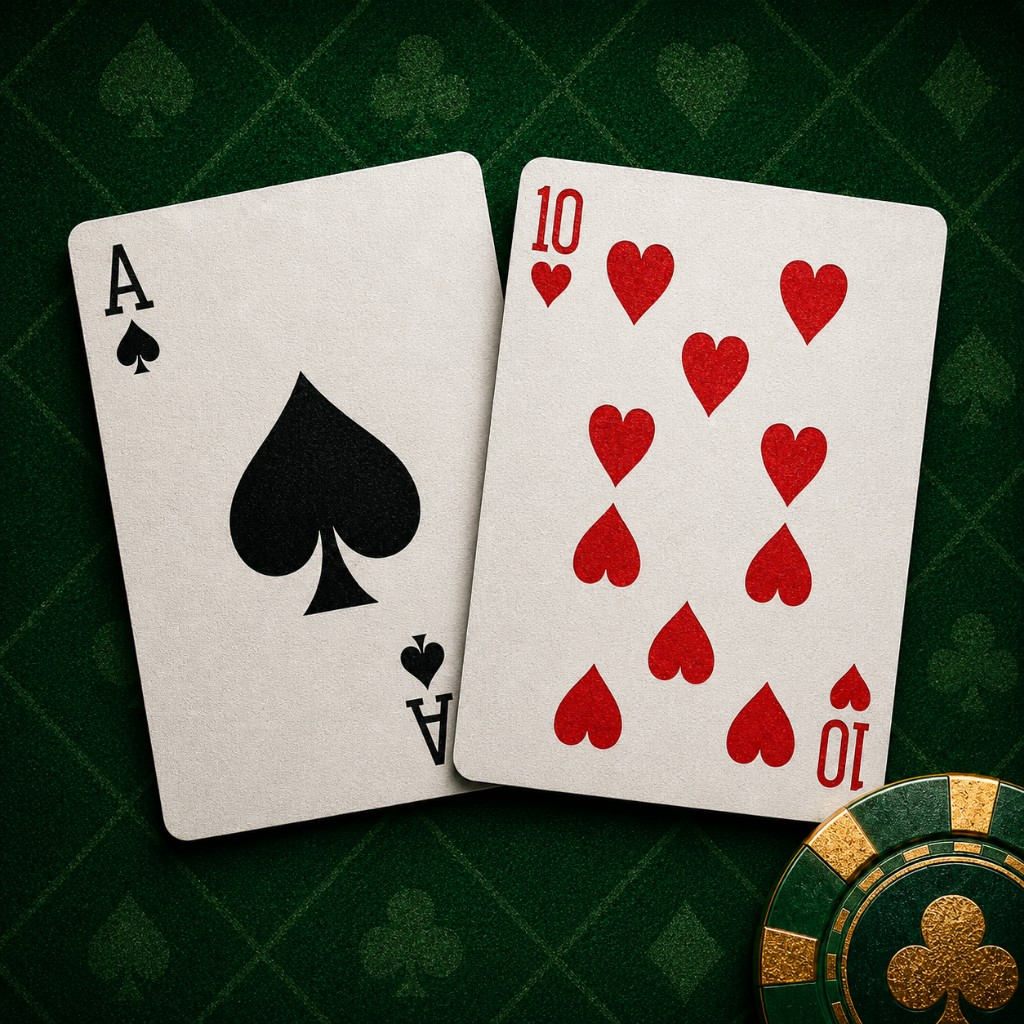
 Blackjack Strategy Trainer 21
The short answer
| Your two-card hand vs dealer 10 | Late surrender offered | No surrender |
|---|---|---|
| Hard 16 (10+6 or 9+7) | SU | H |
| Pair of 8s (S17 or H17) | P | P |
| Pair of 8s (European no-hole-card) | — | H |
SU = surrender, H = hit, P = split, S = stand. These are the same actions the basic strategy chart gives, and the same ones the trainer app grades. A pair of 8s is a hard 16 too, but you split it under standard rules: two hands that start at 8 lose less than one hand at 16. At a European no-hole-card table the chart stops splitting 8s against a 10, so you play them as a normal 16 and hit. Those tables usually do not offer late surrender.
The numbers behind it
Here is what each choice is worth for a 10+6 against a dealer 10, in a 6-deck shoe, after the dealer has checked for blackjack and does not have it:
| Choice | Win | Push | Lose | Average result per $100 bet |
|---|---|---|---|---|
| Stand | 23.0% | 0% | 77.0% | −$54.10 |
| Hit (then stand on 17 or more) | 20.3% | 6.0% | 73.7% | −$53.47 |
| Surrender | — | — | — | −$50.00 |
Win, push and lose are rounded to one decimal. The average column is the exact value, so the rounded rates do not give it to the cent.
Two things stand out. First, surrender beats both other choices by a wide margin: by about $3.50 per $100 bet over hitting, and by about $4.10 over standing, every time this hand comes up. Second, hit beats stand by only about 63 cents per $100. Hit vs stand on 16 against a 10 is one of the closest calls in the whole chart.
Why hit when you bust 61% of the time?
When you hit a 16, any card from 6 to King busts you. In a 6-deck shoe that happens about 61% of the time. It feels like the worst possible move, and that is why so many players stand.
But standing on 16 wins in one case only: the dealer busts. A dealer who shows a 10 and has already checked for blackjack busts only about 23% of the time. Every other time, the dealer finishes on 17 or more and beats your 16. So standing gives you a 23% chance, no more.
Hitting gives you a different chance. An Ace through 5 turns your 16 into 17 to 21. From there you win when the dealer busts or ends lower, and you push when the dealer ties you. That adds up to 20.3% wins and 6.0% pushes. The pushes are the difference: they give your bet back on hands that standing would have lost.
How we got these numbers
We computed them ourselves rather than copying a table. The calculation is exact: it walks every possible card the player and the dealer can draw from the shoe, with the cards already on the table removed, and with the dealer's hole card known not to be an Ace (the dealer has peeked). We then checked it with a simulation of 2 million hands per choice, which landed within a tenth of a cent of the exact values. Assumptions: the dealer peeks for blackjack, you stand on any total of 17 or more after a hit, and the shoe is reshuffled before each hand.
Does the number of decks matter?
It changes how close the call is, not the answer. For a two-card 10+6 against a 10:
| Decks | Stand (per $100) | Hit (per $100) | Hit is better by |
|---|---|---|---|
| 1 | −$54.30 | −$50.69 | $3.61 |
| 2 | −$54.19 | −$52.40 | $1.79 |
| 6 | −$54.10 | −$53.47 | $0.63 |
| 8 | −$54.08 | −$53.60 | $0.48 |
With fewer decks, the cards already dealt matter more. Your 10 and the dealer's 10 take a bigger share of the high cards out of play, and your 6 removes one of the cards that would bust you, so the small cards you need are more likely to come. That makes hitting better. A 9+7 is closer still: in a 6-deck shoe, hitting it beats standing by only 14 cents per $100.
S17 or H17: no difference for this hand
Many charts change when the dealer hits soft 17 (H17). This hand is not one of them. A soft 17 needs an Ace counted as 11, and a dealer who shows a 10 can never count an Ace as 11 after the first two cards: 10 plus 11 is already 21. So the soft-17 rule never applies when the dealer shows a 10. Our calculation gives exactly the same values under S17 and H17.
The H17 surrender changes are all against an Ace: 15, 17 and a pair of 8s become surrenders against an Ace in H17. The surrender guide covers those, and the S17 vs H17 guide lists every cell that changes.
Three-card 16: the one real exception
Basic strategy looks at your total. The exact best play also depends on which cards make that total, because the cards in your hand are no longer in the shoe. When you hit a 16, your good cards are the Ace through 5. If your 16 already uses some of them, fewer are left for you.
| Your 16 (6 decks) | Stand (per $100) | Hit (per $100) | Better play |
|---|---|---|---|
| 7 + 5 + 4 | −$53.92 | −$54.59 | S |
| 5 + 5 + 6 | −$54.27 | −$54.68 | S |
| 4 + 2 + 10 | −$54.12 | −$54.13 | About equal |
| 6 + 4 + 6 | −$54.37 | −$53.93 | H |
A 7+5+4 has used a 5 and a 4, so standing is now slightly better. A 6+4+6 has used two 6s, which are bust cards for a 16, so hitting is still better. The gaps are all under one dollar per $100. If you are not sure, hit as the chart says: getting this exception wrong costs less than one dollar per $100. Surrender is not an option here, because late surrender is only allowed on your first two cards.
Common mistakes with 16 vs 10
Standing because "the dealer has 20 anyway". Standing feels safe because you cannot bust. But a stand wins only when the dealer busts, about 23% of the time. Hitting loses less on average.
Not surrendering when you can. This is the expensive mistake. Hit vs stand is worth about 63 cents per $100. Surrender vs hit is worth about $3.50 per $100. If the table offers late surrender, use it on a two-card hard 16 against a 9, 10 or Ace. A pair of 8s follows its own rule, in the next paragraph.
Surrendering a pair of 8s. Under S17 you split 8s against every dealer card, so they are never a surrender. Under H17 you also split them, except against an Ace, where you surrender if the table allows it. At a European no-hole-card table there is no surrender: you split 8s against a 2 to 9, and hit them against a 10 or an Ace.
Surrendering every 16. Surrender 16 only against a 9, 10 or Ace. Against a 7 or 8 you hit, and against a 2 to 6 you stand. These plays are for a 16 that is not a pair of 8s; a pair of 8s follows its own row of the chart, and you split it in most games.
NOTE
Basic strategy lowers the house edge. It does not remove it. Playing 16 against a 10 perfectly still loses about half the bet on average, because the hand is bad before you make any choice.
Make the right call without thinking
Hard 16 against a 10 comes up often, and the wrong habit costs money every time. Blackjack Strategy Trainer 21 drills the full chart, including surrender under S17 and H17 rules, and brings back the hands you miss until they are automatic. Free on Android and on the App Store.